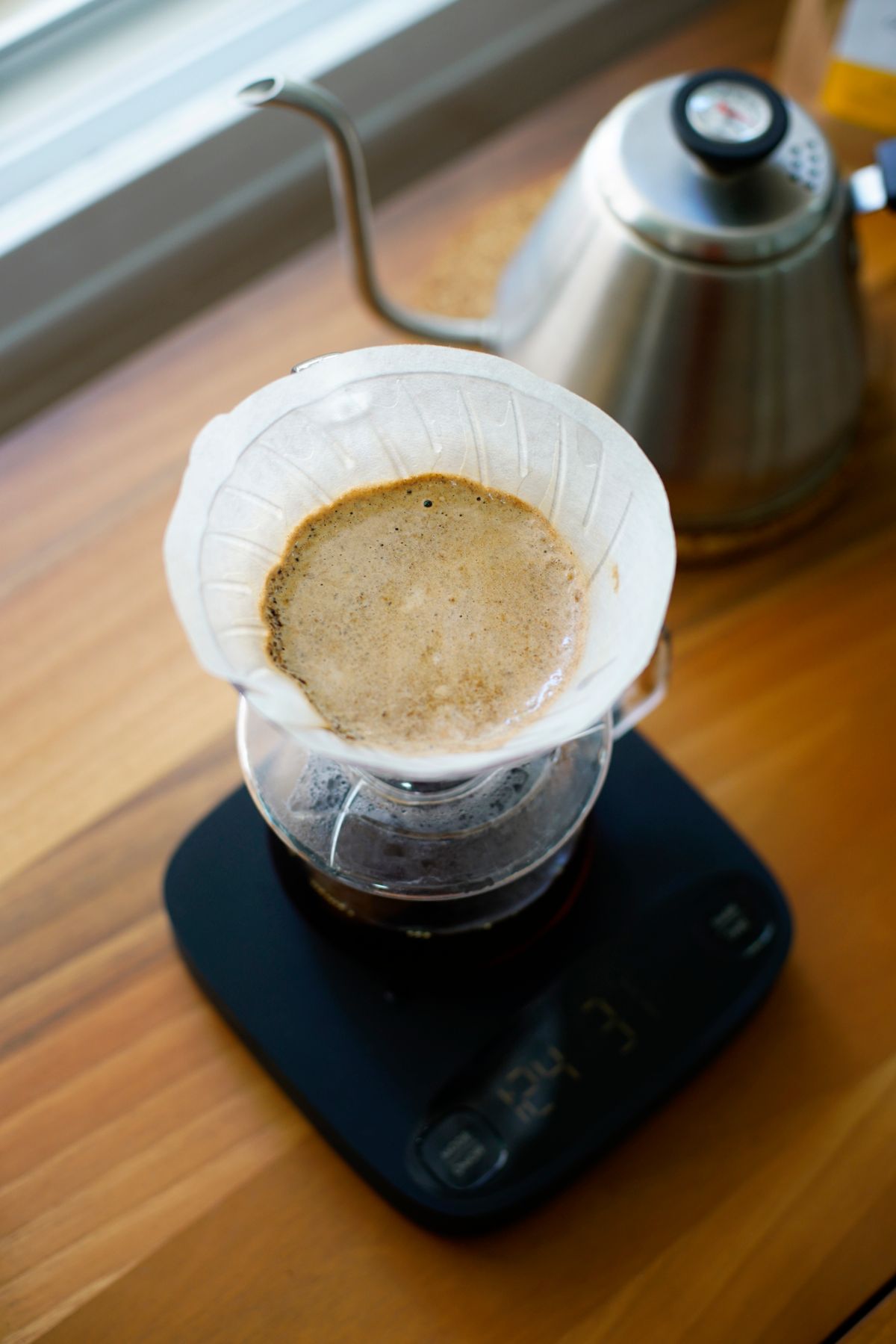
Three ways to make coffee. Three very different mornings.
If you spend enough time reading about coffee, somebody will eventually tell you that you need a particular brewer to make a 'proper' cup. Sometimes it's a lovely glass dripper, sometimes a small plastic press, sometimes an octagonal pot that looks as though it belongs permanently on an Italian hob. Each has its enthusiasts. Each can make excellent coffee. None is going to rescue stale beans or a grinder you've never learnt to adjust.
The question isn't which brewer wins. It's what you want to drink, and what you're prepared to do to make it. A V60 rewards a steady hand and gives you a clean, articulate cup. An AeroPress makes a forgiving small brew with plenty of room for experimentation. A moka pot produces a more concentrated, robust drink with almost no measuring once you've learnt its rhythm.
They aren't interchangeable, and trying to rank them as though they're three versions of the same thing misses most of the pleasure. Let's look at how each one actually works, what changes the flavour and who should reach for which before breakfast.
The useful differences, without the mythology.
Three manual methods
The short version.
| Method | Character | Best reason to choose it |
|---|---|---|
| V60 pour-over | Typically clear, lighter-bodied, more articulate | You enjoy adjusting grind and pouring for a filter-style cup |
| AeroPress | Flexible: clean paper-filtered coffee, or a stronger short brew | You want a compact, forgiving method for one mug |
| Moka pot | Concentrated, heavier, often more intense | You like strong stovetop coffee, including coffee with milk |
These are tendencies, not fixed flavour guarantees. Bean, grind, water, ratio, filter and technique can change the cup substantially.
A useful distinction: the V60 is a percolation brewer. Fresh water moves through a bed of coffee and a paper filter. The AeroPress blends steeping with a short press through a filter. The moka pot heats water in a lower chamber until steam pressure pushes it up through the grounds into the top. It is neither a tiny V60 nor an espresso machine. The mechanics influence the choices you make.
V60: the one that tells you what you're doing.
The Hario V60 is a paper-lined cone with a large opening at the bottom. Water goes in at the top; brewed coffee drains into the cup below. You control much of the flow with your grind, pouring speed, water temperature and the coffee bed itself.
That's the appeal. If you like picking out delicate acidity, sweetness and the subtleties of a well-chosen bean, a paper-filtered pour-over is a very good place to start. Paper catches much of the oil and fine sediment, which often makes flavours feel cleaner and easier to distinguish. But the same exposed mechanics make it less forgiving of hurried, uneven pouring.
Starting recipe: put 15 g of medium-fine coffee into a rinsed size 02 paper filter and brew with 250 g of water at roughly 92–96°C. Wet the grounds with about 45 g, wait 30–45 seconds, then pour the remainder steadily in stages, avoiding the paper edges. Hario suggests a total brew around two and a half minutes; a little longer isn't automatically wrong. The cup, rather than the stopwatch, gets the final vote.
What usually goes wrong? If water rushes through and the coffee tastes thin or sharply sour, try going a little finer. If drainage drags and the cup turns harsh, a coarser setting may help. But keep your dose, water and technique steady while making that change. Otherwise you've changed three things and learnt nothing.
There's a recurring myth that you can't make proper V60 coffee without an expensive precision gooseneck kettle. A controlled pour helps, but a stable ordinary kettle and some patience will get you going. A cheap plastic dripper, paper filters and a decent hand grinder are a much more sensible first investment than a shelf of elegant pouring accessories.
For the step-by-step method, read our V60 guide and then learn to adjust grind by taste. That pairing will do more for your coffee than changing brewers every fortnight.
AeroPress: one mug and several very good ideas.
The AeroPress looks decidedly less ceremonial. A chamber, a plunger, a filter cap and a mug capable of supporting it. Add ground coffee and hot water, let them meet for a short time and press gently through a filter. It's compact, robust in use and surprisingly versatile.
Most people start with a paper filter and a straightforward recipe. Because the coffee spends time steeping before it's pressed, the result can be forgiving when your pour isn't especially careful. Paper still catches much of the sediment and oils, although the taste and body change with steep time, dose, grind and whether you use a different compatible filter.
The maker's standard instructions currently suggest roughly 16–18 g of medium-ground coffee, water up to the chamber's marked level, a short stir and about a minute of contact before a gentle press for common models. That's one starting point, not the one true AeroPress method. Models and chamber markings differ, so use your particular maker's instructions.
Try this simple routine: place a paper filter in the cap, secure it and stand the chamber on a sturdy mug. Add 16 g of coffee, pour in roughly 220–240 g of suitable hot water only if your model has room for that volume, stir briefly, seal with the plunger to limit drip-through and wait about a minute. Press slowly and steadily without leaning your body weight on it. Keep the brewer level. If the chamber's marked capacity is smaller, follow that limit instead of forcing the recipe.
It's an excellent method for experimenting, because you can adjust steeping time, ratio and grind without having to learn a precise pouring pattern. It's also easy to rinse after a brew: the puck pushes out, leaving a few pieces to wash. The disadvantage is that it generally serves one mug at a time. Making four coffees takes repeat rounds or a different, concentrated-brew-and-dilute approach.
Don't mistake the name for pressure-brewed espresso. Pushing by hand through a paper filter is not the same as extracting at the pressure of an espresso machine. An AeroPress can make a strong short drink, but it's still its own category. Our AeroPress history and brewing guide goes deeper into the invention and the technique.
Moka pot: strong coffee with a bit of theatre.
The moka pot is a very different proposition. Put water in the lower chamber, coffee in the funnel basket, screw on the upper collection chamber and heat it on a suitable hob. Pressure generated as the water heats drives water through the coffee and into the upper pot. It makes a compact, concentrated brew with a particular texture and strength.
There's a reason it earns permanent counter space. It asks for little equipment beyond a grinder and a hob, and the coffee is good enough on its own or mixed with warm milk. Unlike an AeroPress or V60, you don't change the water level freely to make any size of drink you fancy. The pot is built around a fixed chamber and basket geometry; its nominal 'cups' are small servings, not standard UK mugs.
Start safely: fill the lower chamber with water to just below the safety valve, not above it. Fit the funnel basket and fill loosely with suitable ground coffee, levelling it rather than tamping it down. Screw the pot together properly and use low-to-medium heat, keeping a gas flame beneath the base rather than licking around its sides. Remove the pot from the heat once the brew has collected, before it splutters away unnecessarily.
Bialetti's instructions are clear on the points that matter: don't overfill the base, don't compress the grounds, don't use excessive heat and wash the aluminium Moka Express by hand. A conventional aluminium Moka Express is not suitable for an induction hob unless you've chosen a compatible model or appropriate adapter.
What does it taste like? Generally more intense than filter coffee. It's not always 'stronger' in every measurable sense, because strength means concentration and caffeine depends on much more than how punchy a mouthful seems. But moka coffee can stand up very nicely to milk. If you want a long, bright, delicate black coffee, the V60 may be your easier route.
A moka pot also asks for a little attention near the end. Wander off until the top is violently gurgling and you'll discover why timing and heat matter. The more useful habit is to listen and watch, then remove it when the coffee has collected. For its story, care and method, read our moka-pot guide.
So which one belongs in your kitchen?
Choose a V60 if you like a longer black coffee, enjoy exploring different beans and don't mind learning a repeatable pouring routine. It's inexpensive to start, easy to clean and wonderfully direct about showing you the effect of grind and water.
Choose an AeroPress if you want a compact brewer for one person, relatively simple cleanup and a great deal of freedom to experiment. It travels well, though you still need a source of hot water. It's an unusually practical compromise between precision and convenience.
Choose a moka pot if you like a shorter, richer stovetop brew, make coffee with milk or enjoy a method that's been doing its job for generations. Learn its fill level and heat, and it becomes wonderfully routine.
If you're buying only one? Think about the drink you order or make most often. A clean black mug points to V60. One-person flexibility points to AeroPress. A punchy little cup or milky breakfast coffee points to moka. If you already own one that makes coffee you enjoy, keep it and improve your method before buying another. Your breakfast doesn't need three departments.
The comparison that's worth doing.
It's tempting to put the same beans through each brewer and declare a winner after three sips. That's not quite a fair fight. Each method needs its own grind and recipe to behave well. A moka pot and a V60 made from exactly the same dose and water won't even produce equivalent drinks.
Instead, choose a coffee you already know, make each brewer's sensible standard recipe, and taste the finished cups at similar drinking temperatures. Note strength, sweetness, acidity, texture, clarity and whether you actually want a second cup. Brew each one well rather than trying to force every machine into identical numbers.
If your V60 seems hollow, don't conclude you hate filter coffee before adjusting the grind. If your moka tastes burnt, don't blame the beans before examining the heat. If your AeroPress is unpleasantly concentrated, consider whether a little dilution brings the balance back.
After you've done this a few times you may find you want different brewers for different mornings. You may also find one is plenty. That's a better outcome than buying all three, arranging them beautifully on the counter and discovering you still haven't finished the bag of coffee from last month.