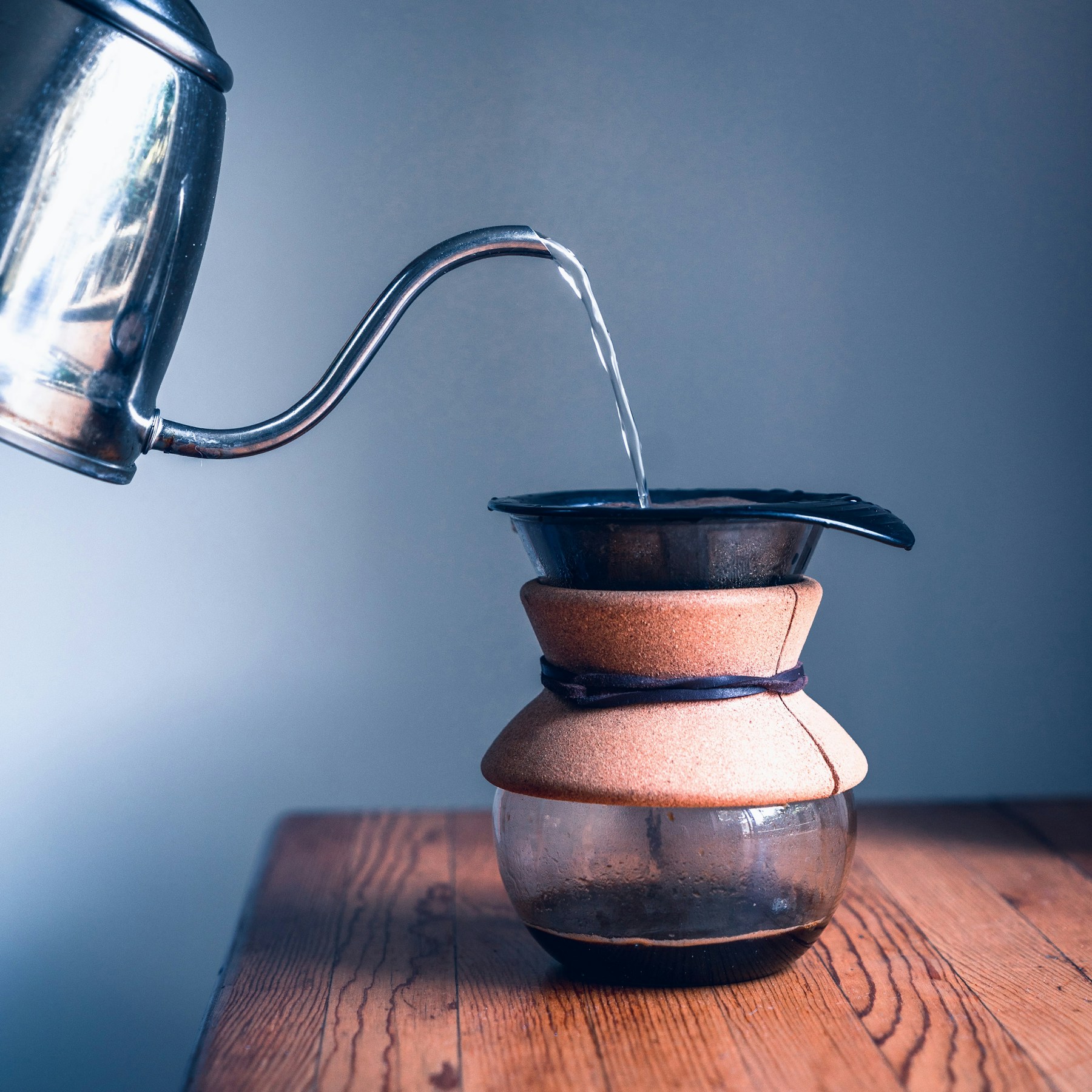
The grinder is not a volume control.
There comes a point in every coffee enthusiast's life when an otherwise rational person begins counting tiny clicks on a hand grinder as though he's trying to defuse an unexploded device. One click finer. Two clicks coarser. A thoughtful pause. Another cup.
It's easy to take the whole business too seriously. But grind size really does matter. It changes how quickly water moves through a bed of coffee, how much surface area is exposed and, ultimately, which flavours end up in your cup. The trick is learning to use the grinder as an instrument instead of spinning the adjustment ring until breakfast disappears.
The important rule is simple: change the grind in response to what you taste, not just what a chart tells you. The difficult part is knowing what the taste is actually saying.
What finer and coarser generally do.
Finer particles expose more surface area. In many brewing setups that means water extracts soluble material more readily; in pour-over it often slows the flow as well. Coarser particles tend to make extraction less efficient and can speed drainage, though the particulars depend on the brewer, the grinder, the coffee and how you pour.
That isn't an iron law of flavour. Coffee isn't a uniform powder: grinders make particles of different sizes, including fines. Water can find channels through an uneven bed, extracting some regions more than others. Change the grind too far in one direction and a supposedly helpful adjustment can make a worse cup.
A useful laboratory study published in Chemosensors in 2024 found that grind and roast level both affected measurements related to strength, extraction and sensory characteristics. Useful science; not a licence to announce that every sour coffee must be ground finer or every bitter one coarser.
First, learn to describe a bad cup.
Sharp and thin: You notice a lemon-like bite without much sweetness or body. That can indicate insufficient extraction, especially if a filter brew drains unusually quickly. But some coffees are naturally bright, and sourness can also emerge from uneven extraction.
Drying and harsh: Your mouth feels rough after swallowing. People often call this bitterness, but astringency is a separate sensation. Overly fine grinding, channelled flow, excessive agitation or the coffee itself may contribute.
Bitter: A taste reminiscent of strong tonic water, very dark chocolate or charred toast, depending on the coffee. Some bitterness is normal and even desirable. Dark roasting can create roasty bitterness that no magical grinder setting can entirely remove.
Weak but pleasant: It tastes fine, there's just not enough of it in the cup. That's a concentration problem as much as an extraction question. Grind might not be the first thing to change.
Flat and papery: Suspect old beans, storage, unsuitable water or stale ground coffee before blaming the dial. A grinder cannot give life back to something that's lost its character.
A proper test you can do tomorrow morning.
Use the same coffee, water, equipment and starting dose for a short series of brews. For a V60, our existing guide uses 15 g coffee to 250 g brewing water; that's a good repeatable starting point. Use the same kettle routine and pour pattern, and write down your grinder setting. The numbers only mean something on your grinder.
- Make your normal cup. Taste it after it cools enough to be comfortable. Record whether it tastes sharp, sweet, muddy, drying or simply weak.
- Change grind only. If the brew is thin and sharply sour, try one modest step finer. If it drains painfully slowly and tastes muddy or harsh, try a small step coarser. These are experiments, not verdicts.
- Keep everything else steady. Dose, water amount, temperature, paper, beans and pouring pattern stay the same. Note the drain time, but don't treat it as the final score.
- Compare at similar temperatures. Coffee tastes different as it cools. Comparing one scalding cup with another at drinking temperature is a good way to learn the wrong lesson.
- Stop when it tastes good. Really. There is no prize for producing the most elaborate brew notebook in Merseyside.
You can go one click finer and find improvement, then another and find that the cup gets worse. Go back. That's not failure; you've learnt roughly where this coffee and method are happiest.
Sometimes the answer isn't the grind.
Suppose your coffee has lovely flavours but feels too heavy. Pour a small amount into another cup and add a little hot water. You've reduced its concentration without extracting anything more from the grounds. If that improves it, look at brew strength or ratio before altering the grinder.
Now imagine a light-roast coffee that's unpleasantly sour despite a sensible grind. Water temperature, brew time, bean development, processing, water chemistry and how evenly you've wetted the coffee can all matter. Coffee has the discourteous habit of being more complicated than a one-page troubleshooting chart.
Change one variable at a time, but don't cling to a bad starting method out of principle. If a brewer is producing wildly inconsistent cups, check your pouring and agitation. If the grinder makes an excessive amount of fine dust, its particle distribution may limit how clean the brew can become. The most expensive settings in the world won't fix a badly maintained grinder.
Different brewers, different consequences.
V60 and other pour-over brewers: Grind directly affects the bed's resistance and flow, so drainage time is useful supporting information. A finer setting may increase extraction, but it may also choke the brew or lead to uneven flow.
AeroPress: Because water and coffee sit together before pressing, the relationship between grind and total time is different. Start medium-fine, keep steep and stirring consistent, and adjust taste. If the plunger needs excessive force, don't press harder — reassess the grind and check the filter. See our AeroPress guide.
Moka pot: Grind affects flow through a confined basket under heat-driven pressure. It's not the place for tamping or espresso-fine experimentation that risks impeding flow. Keep the basket loosely level and follow the manufacturer's safety instructions. Read the moka guide.
Cafetière: Immersion is generally less dependent on flow resistance, but fines and filtration affect sediment and texture. There's no sacred rule that it must always use boulder-sized grounds.
A useful little tasting note.
Here's the sort of record worth keeping: “Colombian medium roast. V60, 15 g / 250 g, grinder setting 18. 2:55 total. Sweet but slightly drying as it cools. Try one step coarser.”
Compare that with “setting 18 is perfect for all V60 coffee”, which tells you very little and is almost certainly nonsense. Bean density, roast, age and the individual grinder all change the answer.
When you've got the method under control, the genuinely enjoyable work begins: comparing coffees from different places without accidentally comparing your own brewing mistakes. That's where our guide to finding your coffee comes in.
The point of the exercise.
You're not trying to extract the largest possible number from a bag of beans. You're trying to make something you'd like to drink again. A good grind setting is the one that helps this coffee, with this brewer and this recipe, taste the way you want it to.
And if breakfast becomes an endless argument with the adjustment dial, make a decent cup, drink it, and come back to the experiment tomorrow. Coffee is supposed to improve your morning. It needn't become the reason you miss it.