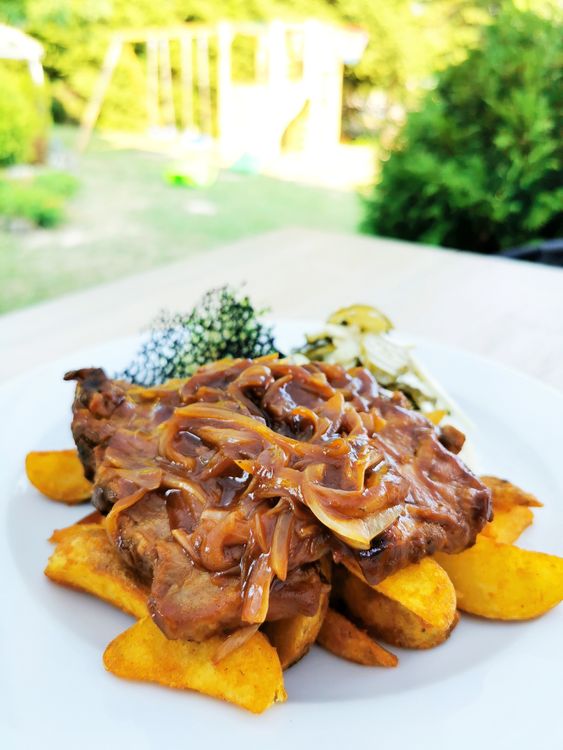
There's no romance in wasting the animal.
It's fashionable to talk about respecting ingredients while quietly pretending the animal began life as a packet of boneless steaks. Liver tends to expose the hypocrisy. It isn't neat, it isn't fashionable, and it tastes unmistakably of what it is. A strong, mineral, deeply savoury organ that either makes you hungry or sends you running for the potatoes.
Good. Food is allowed to have an opinion. The butcher's counter has plenty of anonymous beige stuff already.
Four livers, four different propositions.
Chicken liver is relatively small, rich and soft-textured. It's excellent with onions, toast and sharp vinegar; properly cooked chicken-liver pâté is another classic, although undercooking it is a serious Campylobacter risk. Lamb's liver can be more robust, often appealing with smoky bacon and onions. Calf's liver is commonly prized for a finer, milder texture but commands a premium. Beef liver is stronger in flavour and can be magnificent when prepared thoughtfully; it is also remarkably unforgiving if you boil the life out of it.
Ask your butcher to trim membranes, remove ducts and slice large pieces evenly. You can soak stronger liver briefly in milk if you prefer the flavour that way; it isn't a magical purification ritual or a substitute for freshness and safe cooking.
Why bother eating it?
Liver contains high-quality protein, iron, vitamin B12, folate and substantial amounts of preformed vitamin A; it's also a source of copper. Some of those nutrients are hard to get in similar amounts from more conventional cuts. That's a genuine nutritional advantage — and, with vitamin A, an important reason not to treat liver like a daily supplement.
NHS advice is to avoid eating liver or liver products more than once a week. Pregnant people should avoid it. Those taking supplements containing vitamin A need particular care, since liver can supply a lot of retinol in a single meal. More isn't automatically better; your body does not award medals for heroic vitamin consumption.
A little respect for the cheaper cuts.
For generations, offal was ordinary food rather than a challenge on a cooking show. Hearts, kidneys, tongues and livers went into kitchens that understood the cost of an animal and had no interest in pretending the rest of it didn't exist. Somewhere along the way, we got squeamish and decided only the neatest muscles deserved a place at dinner.
Liver doesn't need a campaign to make it fashionable. It needs a hot pan, onions cooked patiently until sweet, and something acidic to cut through its richness. Do it well and it's a serious plate of food. Do it badly and you'll understand every grim school-dinner memory attached to the word.
Method one: liver, onions and something sharp.
For two people, use 300–350 g / 11–12 oz evenly sliced lamb or beef liver, two onions, 1 tbsp butter, 1 tbsp oil, black pepper, a spoon of flour if desired, and a splash of cider vinegar or sherry vinegar. Cook the onions slowly in a skillet until sweet and brown, then lift them out. Dry and lightly flour the liver, if using flour, and sear in a hot pan until browned.
Finish until thoroughly cooked. Unlike a whole-cut steak, offal needs cooking through. Use a clean fine-tip thermometer and a validated safe combination such as 70°C / 158°F held for two minutes, following UK FSA guidance. Reduce the heat as needed to avoid making the exterior leathery. Return onions and a little liquid to glaze, finish with vinegar and serve immediately.
Method two: chicken livers with garlic and parsley.
Use 350 g / 12 oz trimmed chicken livers, 1 chopped shallot, a little butter or oil, 1 clove garlic, chopped parsley and 1 tbsp red wine vinegar. Sweat the shallot, add the livers in a single layer, brown them, then cook them all the way through — poultry livers may contain pathogens inside as well as on their surface. Follow the FSA's 70°C for two minutes or an equivalent validated combination; the US minimum for poultry is 74°C / 165°F. Finish with garlic and vinegar, then parsley. Heap onto toasted sourdough.
Method three: liver with bacon, cast iron and smoke.
Cook slices of bacon separately until crisp. In a clean cast-iron skillet on a barbecue with controlled heat, soften onions, then brown even slices of lamb's liver and cook through to the same safe internal standard. Keep raw-liver tools away from finished bacon and garnish. Return the onions and bacon only once the liver is properly cooked. A few minutes of indirect smoke from a mild wood can add another note, but the cook is too short for an elaborate smoking performance.
The part nobody puts on a menu.
Buy fresh liver from a reputable supplier and store it chilled. Don't pretend the occasional iron-rich dinner is a cure for anaemia or a reason to ignore medical advice. It is food: intensely flavoured, historically ordinary, and worthy of better treatment than a joke about school dinners.
Leave room for people who simply don't like it. That's their business. But if the meat industry insists that every animal become steaks and boneless chicken breasts, we lose more than a few old recipes. We lose the habit of thinking about what we're eating.